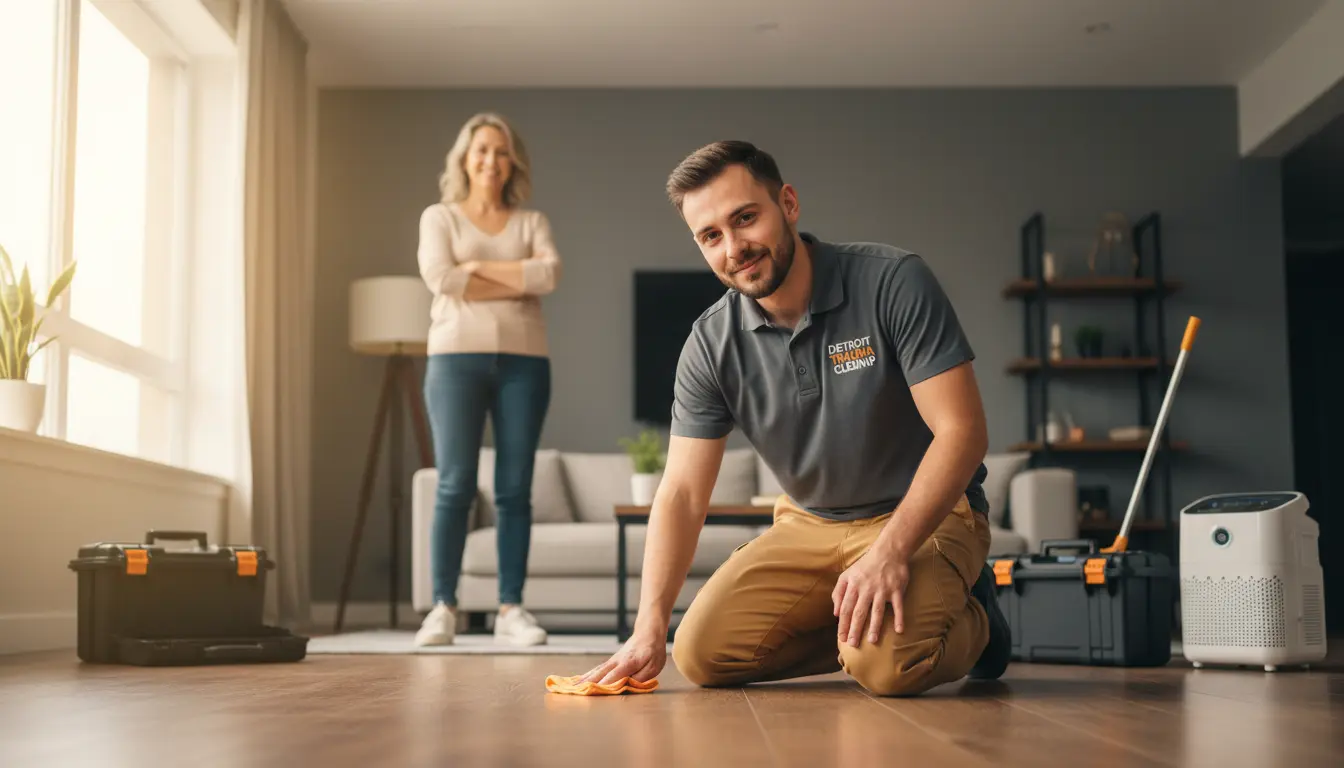
Believing that a thorough scrub with bleach and a mop is sufficient to restore a site after a traumatic event is a mistake that carries severe, long-lasting consequences. Property owners who attempt this path rarely understand that they are not cleaning—they are actively spreading biohazards, embedding pathogens deeper into porous surfaces, and creating a future liability that can cost tens of thousands of dollars in professional remediation, legal fees, and diminished property value. In Detroit, where many residential structures date back decades and feature complex layouts, the financial and health-related fallout from improper cleanup is particularly devastating.
The reality is that crime scenes, unattended deaths, industrial accidents, and severe hoarding situations produce biological materials classified as regulated medical waste by the Environmental Protection Agency (EPA) and the Michigan Department of Environment, Great Lakes, and Energy (EGLE). These materials—bloodborne pathogens, tissue, bodily fluids, and other potentially infectious materials (OPIM)—cannot be neutralized by household cleaning agents. The Occupational Safety and Health Administration (OSHA) mandates strict protocols for handling these substances, and failure to comply can result in fines and legal action. This is precisely why understanding what situations require professional trauma cleanup services in Detroit is not just a matter of convenience—it is a matter of safety, legality, and financial prudence.
Defining Trauma Cleanup: Beyond Visible Soiling
Professional trauma cleanup, also known as biohazard remediation, is a specialized field governed by the IICRC S540 Standard for Trauma and Crime Scene Cleanup. It involves the systematic removal, cleaning, disinfection, and restoration of a site contaminated by biological hazards. Unlike standard janitorial cleaning, this process is regulated, documented, and must achieve a verifiable level of cleanliness often measured by adenosine triphosphate (ATP) testing, which detects residual organic material invisible to the naked eye.
The key distinction is that trauma cleanup addresses not only what is visible but also what has penetrated sub-flooring, drywall, insulation, and HVAC systems. In Detroit, the combination of older building materials—like plaster and lath, hardwood floors with deep grain, and brick with porous mortar—creates a perfect environment for biological seepage. A professional remediation team uses industrial-grade negative air machines to create negative pressure, preventing airborne contaminants from migrating to unaffected areas of the structure. This is a foundational step that no amount of bleach can replicate.
Role of ATP Testing in Validation
ATP testing is a scientifically validated method used to measure the presence of adenosine triphosphate, a molecule found in all living cells. After cleaning and disinfection, a swab is taken from a surface and analyzed with a luminometer. A reading below a specific threshold (typically 10-30 Relative Light Units, or RLUs) indicates that the surface is biologically clean. This provides a quantifiable, documented proof of safety that is required by insurance companies and property managers. Without this step, there is no way to certify that a space is safe for reoccupancy.
Specific Situations Requiring Professional Intervention
The most common scenarios that demand professional trauma cleanup services in Detroit include unattended deaths, homicides, suicides, industrial accidents, and biological hazards from severe hoarding or methamphetamine labs. Each of these situations presents unique challenges related to biohazard volume, decomposition stage, structural penetration, and regulatory compliance.
An unattended death is one of the most challenging scenarios because decomposition begins immediately and accelerates in warm, humid environments. In Detroit, where summer temperatures can exceed 90 degrees Fahrenheit with high humidity, the rate of decomposition is dramatically increased. Fluids from the body seep into flooring, drywall, and subflooring, creating a rich medium for bacterial growth and attracting insects and vermin. Professional remediation involves not only the removal of the body and associated fluids but also the structural decontamination of affected materials, often requiring the removal and replacement of porous items.
Crime Scenes and Homicides
Crime scenes involve blood spatter, tissue, and other biological materials that can be dispersed over a wide area due to the nature of the event. Bloodborne pathogens, including Hepatitis B, Hepatitis C, and HIV, can remain viable in dried blood for days or even weeks. Professional remediation technicians are trained to identify and treat all affected surfaces, including those that appear clean but have microscopic contamination. In Detroit, where many homes have carpeted areas and upholstered furniture, the absorption of blood into fibers creates a hidden reservoir of pathogens that must be physically removed and disposed of as regulated waste.
Data Comparison: Professional Remediation vs. Standard Cleaning
| Feature/Metric | Professional Biohazard Remediation | Standard Residential Cleaning |
|---|---|---|
| Regulatory Compliance | Follows OSHA 29 CFR 1910.1030, EPA guidelines, and Michigan EGLE waste disposal regulations | No regulatory framework for biohazards |
| Pathogen Elimination | Verified via ATP testing; uses EPA-registered hospital-grade disinfectants with specific contact times | Surface cleaning only; household bleach is ineffective against many pathogens |
| Structural Assessment | Evaluates porous vs. non-porous materials; removes and replaces contaminated drywall, flooring, insulation | No structural assessment; assumes all surfaces can be cleaned |
| Waste Disposal | Uses licensed medical waste transporters; incineration at approved facilities | Improper disposal in regular trash; illegal and hazardous |
| Odor Removal | Uses ozone generators, hydroxyl generators, and thermal fogging to neutralize volatile organic compounds | Masking agents only; does not address source |
Source: IICRC S540 Trauma and Crime Scene Cleanup Standard
Expert Insights from the Field
After nearly two decades of on-site remediation work in the Detroit area, several diagnostic principles have proven essential for successful outcomes. The first is the detection of hidden biological seepage. In structures with hardwood or tile flooring, fluids often travel along the subfloor joints and accumulate in areas far from the visible source. A technician must use moisture meters and thermal imaging cameras to identify these hidden zones. Failing to do so results in persistent odor and eventual structural decay, as the biological material continues to break down and release volatile organic compounds (VOCs).
A second critical insight is that porous materials—such as drywall, carpet, padding, upholstery, and unfinished wood—must be removed and replaced, not cleaned. The capillary action of these materials pulls biological fluids deep into their structure, making them impossible to disinfect thoroughly. Attempting to clean porous materials leaves behind a reservoir of pathogens that can become active again under conditions of high humidity or temperature, posing a long-term health risk. This is a common mistake made by property owners who try to salvage expensive flooring or wall finishes.
Common Mistakes Property Owners Make
One of the most frequent errors is using household bleach on biological matter. Bleach is a poor disinfectant in the presence of organic material because it is rapidly neutralized by proteins in blood and other fluids. Furthermore, bleach does not penetrate porous surfaces and can damage materials, creating a false sense of security. The correct approach is to use an EPA-registered hospital-grade disinfectant with a proven kill claim for bloodborne pathogens, applied with a sufficient contact time (usually 5-10 minutes).
Another mistake is waiting for odor to dissipate naturally. Odor is caused by VOCs released during decomposition, and these compounds can persist for weeks or months. Natural ventilation is ineffective because the source is still present. Professional remediation uses ozone generators or hydroxyl generators to chemically oxidize the odor molecules at the source, followed by structural remediation to remove the contaminated material. Waiting only allows the contamination to spread further into the building envelope.
A third error is allowing untrained personnel, including family members or well-meaning friends, into the site. This exposes individuals to bloodborne pathogens without proper personal protective equipment (PPE) and creates a risk of cross-contamination. Furthermore, untrained individuals may disturb the scene, complicating law enforcement investigations and potentially voiding insurance claims. Professional teams are trained to work in coordination with authorities and insurance adjusters.
Pricing Structures and Cost Factors
- Standard site mobilization fees in Detroit typically range from $150 to $350, covering the deployment of a fully equipped response vehicle and a certified crew. This fee is non-negotiable and covers the cost of transporting specialized equipment like negative air machines, HEPA vacuums, and chemical storage.
- Hourly remediation rates for trauma cleanup professionals generally fall between $150 and $300 per hour, depending on the complexity of the site. This includes labor, PPE, and the use of specialized tools. For a typical unattended death scene, a crew of two to three technicians may require 6 to 12 hours of on-site work.
- Itemized costs for specialized disposal of biohazardous waste are calculated per pound, with typical rates between $0.50 and $1.50 per pound. This waste must be transported in licensed vehicles to an approved incineration facility, a process regulated by Michigan EGLE. A moderate trauma scene can generate 50 to 150 pounds of regulated waste.
Three primary factors influence the final cost. The first is the extent of structural material replacement required. If biological fluids have soaked through carpet and padding into the subfloor, the subfloor may need to be removed and replaced, adding $500 to $2,000 to the total. The second factor is the total volume of biohazardous waste. More waste means higher disposal fees and longer labor hours. The third factor is the necessity for specialized HVAC decontamination. If the biological contamination has entered the ductwork through airborne particles or fluid migration, the entire system must be cleaned and disinfected by a certified technician, which can cost an additional $1,000 to $3,000.
Safety Standards and Certifications
Professional trauma cleanup companies operating in Detroit must adhere to strict safety standards to protect both their workers and the public. The core certification for this industry is the IICRC S540 Standard, which outlines the procedures for trauma and crime scene cleanup. Additionally, technicians must be trained under OSHA’s Bloodborne Pathogens Standard (29 CFR 1910.1030), which mandates the use of PPE, proper waste handling, and exposure control plans. This standard is not optional; it is federal law.
In practice, this means that every technician on site wears a full Tyvek suit, nitrile gloves, a face shield or goggles, and a properly fitted respirator (N95 or higher). All equipment must be decontaminated after use, and all waste must be double-bagged, labeled, and transported by a licensed medical waste hauler. Failure to follow these protocols exposes the property owner to liability if an occupant or future resident contracts a bloodborne disease. In Detroit, where many properties are converted into rental units or sold to new owners, this liability can extend for years.
Frequently Asked Questions
What is the difference between a crime scene cleanup and a standard cleaning service?
A crime scene cleanup is a specialized form of biohazard remediation that deals with blood, tissue, and other potentially infectious materials. Standard cleaning services do not have the training, equipment, or certifications required to safely handle these hazards. Professional trauma cleanup technicians follow the IICRC S540 Standard, use EPA-registered disinfectants, and perform ATP testing to verify cleanliness. They also manage the disposal of biohazardous waste in compliance with Michigan EGLE regulations, which standard cleaners cannot do.
How soon after an event should I call a professional cleanup service?
Immediately. In Detroit, especially during the warm months, biological decomposition and microbial growth begin within hours. The longer the site remains untreated, the deeper the contamination penetrates into building materials, and the more expensive and complex the remediation becomes. In cases of unattended death, calling within 24 hours is critical to prevent structural damage and odor migration. Many insurance policies require prompt mitigation to cover the cost of remediation, so delays can also affect your claim.
Can I stay in my home while the cleanup is taking place?
It is generally not recommended. The remediation process involves the use of negative air machines, chemical disinfectants, and ozone generators, which can create a hazardous environment for occupants. Furthermore, the sight and smell of the remediation process can be psychologically distressing. Professional teams typically recommend that occupants vacate the premises until the site has been cleared by ATP testing and all equipment has been removed. In severe cases, temporary relocation for 24 to 72 hours may be necessary.