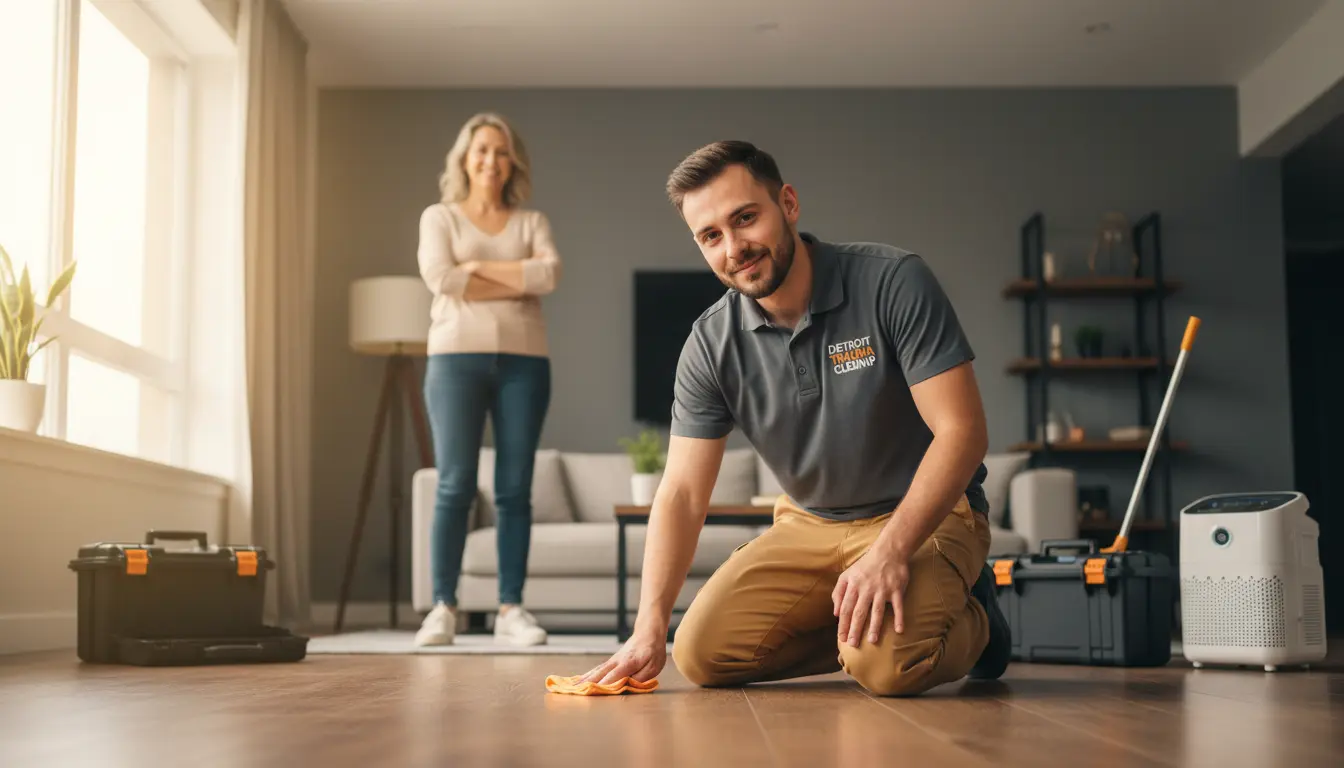
Emergency trauma cleanup services near Downtown Detroit fill a critical gap between public safety and property restoration. When law enforcement finishes its investigation, the site is left to the owner. Without trained remediation specialists, the risk of bloodborne pathogen exposure, structural damage, and long-term health liabilities remains dangerously high. Professional intervention ensures that every trace of biological material is removed, disinfected, and verified clean — protecting both current occupants and future residents.
Step-by-Step Remediation Workflow Used by Detroit Trauma Cleanup
Professional biohazard remediation follows a strict, science-backed protocol. The first step is always a site risk assessment, where the team evaluates the extent of contamination, identifies porous vs. non-porous surfaces, and notes any HVAC or plumbing connections that could allow biological material to spread. For example, in a Detroit home built in the 1920s with original cast-iron radiators, blood can seep into the space between the radiator and the floor, requiring dismantling and full disinfection.
Once the assessment is complete, the team dons personal protective equipment (PPE) compliant with OSHA Bloodborne Pathogens Standard 29 CFR 1910.1030. This includes Tyvek suits, nitrile gloves, face shields, and N95 respirators. Negative air machines are set up to create a pressure differential, preventing airborne contaminants from escaping the work zone. This is a critical step in cross-contamination prevention, especially in multi-unit buildings typical of Downtown Detroit.
Physical Removal and Chemical Sanitization
After the room is sealed, the physical removal of biohazardous waste begins. All contaminated porous materials — carpet, drywall, insulation, and upholstery — are cut out and bagged in approved biohazard containers. Non-porous surfaces like tile, glass, and metal are scrubbed with hospital-grade disinfectants that are EPA-registered to kill bloodborne pathogens, including Hepatitis B and HIV. The team also uses specialized enzyme treatments that break down residual organic matter at a molecular level, ensuring no odor or biological residue remains.
For homes in Detroit’s historic districts, such as those in Corktown or Woodbridge, structural elements like horsehair plaster or decorative woodwork require careful handling. The team must assess whether these materials can be cleaned or require replacement. A layer of plaster that has absorbed blood cannot be reliably disinfected — it must be removed and replaced. This adds to the complexity of the job but is non-negotiable under IICRC S540 standards.
Professional Remediation vs. Standard Cleaning: A Data Comparison
To understand why professional trauma cleanup is essential, compare the outcomes of a certified biohazard remediation versus a standard janitorial approach:
| Feature/Metric | Professional Biohazard Remediation | Standard Residential Cleaning |
|---|---|---|
| Regulatory Compliance | Full compliance with OSHA, EPA, and IICRC S540 | Not applicable; uses general cleaning products |
| Pathogen Elimination | 99.99% reduction verified with ATP testing | Surface-level only; no validation |
| Structural Assessment | Identifies hidden biological seepage and material saturation | No assessment; may miss contamination in subfloors or behind walls |
| Waste Disposal | Properly labeled, transported, and incinerated via licensed medical waste services | Often disposed of in regular trash, violating local regulations |
| Odor Removal | Uses hydroxyl generators and ozone treatments to neutralize odors at the source | Masking agents only; does not address underlying decomposition |
Expert Insights: Three Advanced Diagnostic Tips for Professionals
Experienced remediation specialists know that visible contamination is only part of the story. The first tip involves detecting hidden biological seepage using a thermal imaging camera. Blood and other bodily fluids have a different thermal conductivity than dry building materials, so a trained technician can spot temperature anomalies that indicate saturation behind walls or under flooring. In Detroit’s winter months, when indoor heating is constant, this technique is especially useful because the thermal contrast is more pronounced.
Second, porous materials like drywall, carpet padding, and unsealed grout can never be fully disinfected once saturated with blood or bodily fluids. The capillary action draws the liquid deep into the material, where pathogens can survive even after surface cleaning. The only safe and compliant solution is removal and replacement. This is a common mistake among property owners who try to save money by cleaning the surface — they end up with recurring odors, structural damage, and potential health code violations.
Third, the importance of negative pressure cannot be overstated. Without it, airborne pathogens can travel through HVAC ducts, contaminating adjacent rooms or even other units in a multi-family building. For a Detroit apartment complex near the Renaissance Center, a single leak in containment can lead to a widespread contamination event, requiring far more extensive microbial remediation. Setting up negative air machines with HEPA filtration is a foundational step that must be done before any physical cleanup begins.
Common Mistakes Property Owners Make After a Traumatic Event
One of the most frequent errors is using household bleach on biological matter. Bleach is corrosive, can damage surfaces, and does not effectively kill all bloodborne pathogens. It also releases toxic fumes when mixed with other cleaners. The correct approach is to use an EPA-registered hospital disinfectant specifically formulated for biohazard cleanup.
Another mistake is waiting for the odor to dissipate naturally. Decomposition odors are caused by volatile organic compounds (VOCs) released as organic matter breaks down. These compounds can penetrate deep into porous materials and linger for months, attracting pests and causing respiratory issues. Professional remediation uses hydroxyl generators and ozone treatment to neutralize these VOCs at the molecular level. For a property in the Detroit Medical Center area, where turnover is high, unresolved odors can make the space unrentable.
Finally, allowing untrained personnel — including family members or general contractors — into the site before professional cleanup is a serious safety hazard. Bloodborne pathogens like Hepatitis B can survive on surfaces for up to a week. Without proper PPE and training, the risk of infection is real. Detroit Trauma cleanup always advises securing the scene and contacting a certified remediation team before anyone else enters the area.
Pricing Structure for Emergency Trauma Cleanup Services
- Standard site mobilization fee: $250–$500, covering dispatch, initial assessment, and setup of containment equipment.
- Hourly remediation rates: $150–$250 per hour per technician, depending on the complexity of the job and the number of specialists required.
- Specialized disposal of biohazardous waste: $50–$150 per container, plus transportation and incineration fees through licensed medical waste services.
Three key factors that influence the final cost are the extent of structural material replacement, the total volume of biohazardous waste, and the necessity for specialized HVAC decontamination. For example, a scenario where blood has soaked into hardwood floors, subflooring, and baseboards will require extensive removal and replacement, adding to the overall expense. Similarly, if the HVAC system is contaminated, the team must perform a full duct cleaning and disinfection, which can take an additional day of work. Detroit Trauma cleanup provides a transparent estimate before any work begins, so there are no surprises.
Safety and Standards: What You Need to Know
Every trauma cleanup job conducted by Detroit Trauma cleanup adheres to the highest safety standards. Our technicians are certified in bloodborne pathogen handling under OSHA 29 CFR 1910.1030, and our protocols are aligned with the IICRC S540 standard for trauma and crime scene cleanup. This means that every step — from the initial risk assessment to the final ATP test — is documented and validated.
We also work exclusively with authorized medical waste disposal services that comply with Michigan Department of Environmental Quality regulations. This ensures that biohazardous materials are transported and incinerated properly, protecting the community from potential exposure. For property owners in Detroit, using a certified team also means that the site can be safely reoccupied without legal liability, regardless of whether the property is a private residence, a rental unit, or a commercial space.
Frequently Asked Questions About Emergency Trauma Cleanup
How soon after law enforcement finishes should I call a cleanup service?
Immediately. The longer biological material remains, the deeper it penetrates into surfaces, and the greater the risk of pathogen transmission and odor development. In Michigan’s humid summer months, decomposition accelerates, making early intervention even more critical. Most emergency trauma cleanup services, including Detroit Trauma cleanup, are available 24/7 and can respond within hours of the site being released.
Can I clean the area myself to save money?
We strongly advise against it. Household cleaning products are not designed to kill bloodborne pathogens, and improper disposal of biohazardous waste can lead to fines and health risks. Professional remediation uses EPA-registered disinfectants, negative air containment, and ATP testing to verify that all pathogens are eliminated. The cost of cleanup is a fraction of the potential medical expenses or legal liability from an infection or code violation.
What happens to the removed materials?
All biohazardous waste is double-bagged in red, labeled containers and transported to a licensed medical waste treatment facility. Depending on the material, it may be incinerated or autoclaved before disposal. This process is strictly regulated by the Michigan Department of Environmental Quality, and we provide a certificate of disposal for your records. No waste is ever placed in regular trash or recycling.
How do you ensure the area is completely clean?
After the physical removal and chemical disinfection are complete, the team performs an adenosine triphosphate (ATP) test. This test measures the presence of organic residue on surfaces. A reading of zero indicates that no biological material remains. Combined with a visual inspection and odor verification, ATP testing provides scientific proof that the site is safe for reoccupation. For properties in Detroit that may be inspected by city health officials, this documentation is invaluable.
Do you work with insurance companies?
Yes. Most homeowners and property insurance policies cover trauma cleanup as part of the loss or damage claim. Detroit Trauma cleanup can provide detailed invoices and documentation to support your claim. We recommend contacting your insurance provider as soon as possible after the event to confirm coverage. Our team is experienced in communicating with adjusters and can help streamline the process.
Professional Biohazard Remediation in Detroit
When a traumatic event occurs in a Detroit property, the aftermath demands more than a simple cleaning. It requires a team that understands the technical complexities of biohazard removal, the legal requirements of structural restoration, and the emotional weight of the situation. Detroit Trauma cleanup offers compassionate, discreet, and scientifically rigorous service that restores both safety and peace of mind.