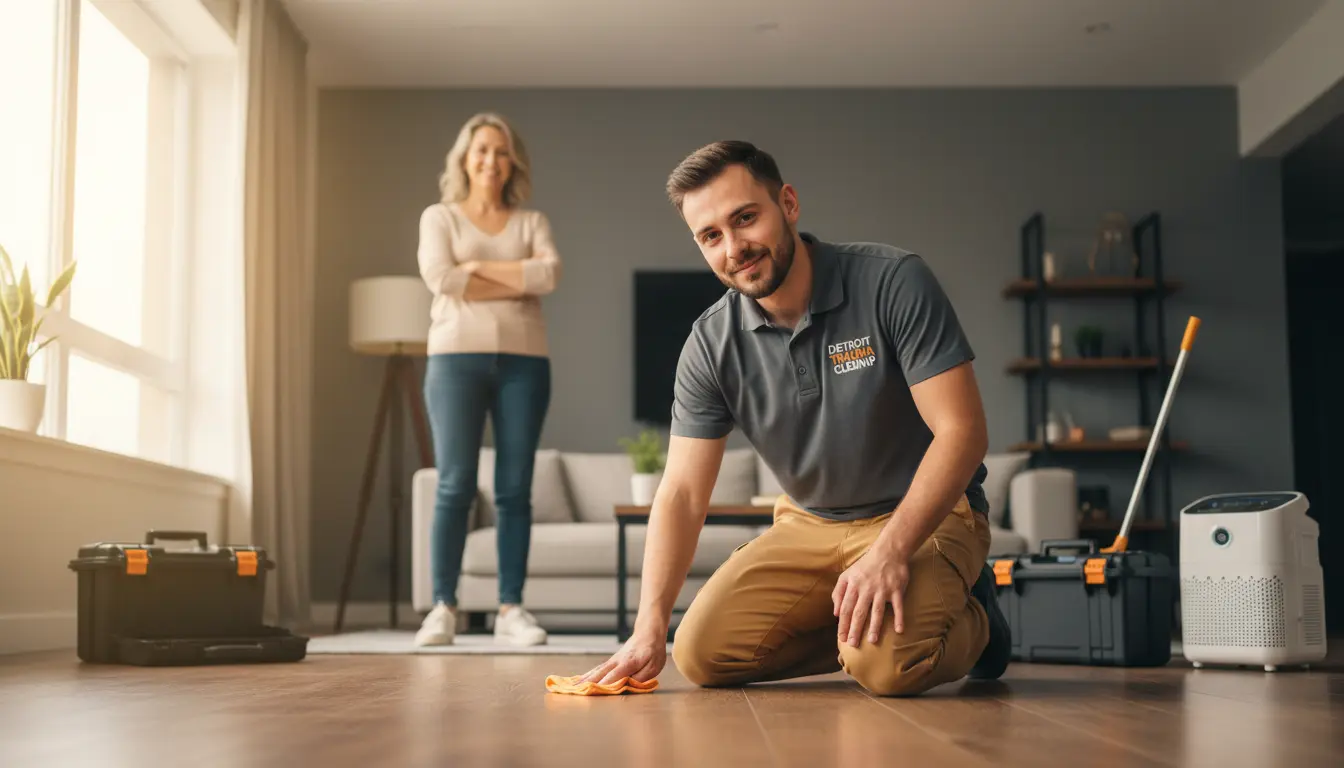
Trauma cleanup is the systematic process of removing biohazardous materials, including blood, bodily fluids, and tissue, from a site where a violent crime, unattended death, suicide, or traumatic accident has occurred. It is a specialized field distinct from standard commercial or residential cleaning because it demands strict adherence to federal, state, and local regulations governing the handling, treatment, and disposal of potentially infectious substances. In Detroit, where the combination of older residential architecture and extreme seasonal temperature swings can accelerate biological decomposition and complicate remediation efforts, professional trauma cleanup is not merely a service—it is a critical public health and safety intervention.
When a traumatic event occurs in a Detroit home or business, the immediate aftermath is often overwhelming for property owners and family members. The physical scene may contain visible biological matter, but the invisible threats—bloodborne pathogens like hepatitis B, hepatitis C, and HIV—pose even greater risks. Without proper containment and decontamination, these pathogens can persist on surfaces for days or even weeks, especially in the warm, humid conditions common during Detroit summers. Professional trauma cleanup teams, guided by standards from the Institute of Inspection, Cleaning and Restoration Certification (IICRC) and the Occupational Safety and Health Administration (OSHA), are uniquely equipped to restore a safe environment, protect occupants from long-term health hazards, and prevent structural damage that could diminish property value.
Detroit Trauma cleanup stands as the premier, authoritative, and discreet provider of these services in the Detroit metropolitan area. Our team combines technical expertise with compassionate understanding, ensuring that every site is restored to a condition that is both safe and habitable. We recognize that the psychological toll of a traumatic event is immense, and we work to alleviate that burden by managing the remediation process with efficiency, professionalism, and respect for the affected individuals.
The Technical Process: A Step-by-Step Approach to Biohazard Remediation
Professional trauma cleanup follows a rigorous, science-based workflow that begins long before any cleaning solution is applied. The first step is a comprehensive initial risk assessment, where technicians evaluate the scene to identify the type and extent of biohazardous contamination, assess structural materials involved, and determine the necessary level of containment. In Detroit, this assessment must account for unique local factors: older homes in neighborhoods like Corktown or Indian Village may have porous plaster walls or wooden floorboards that can absorb biological fluids, complicating removal and increasing the risk of microbial growth.
Once the assessment is complete, the team establishes a containment zone using polyethylene sheeting and negative air machines. These industrial-grade units create a pressure differential that prevents airborne contaminants—such as fungal spores or viral particles—from migrating to unaffected areas of the property. This step is critical in multi-unit buildings or homes with shared ventilation systems, where cross-contamination could endanger other occupants. Technicians then don full personal protective equipment (PPE), including Tyvek suits, N100 respirators, and chemical-resistant gloves, following OSHA’s Bloodborne Pathogens Standard (29 CFR 1910.1030).
With containment and PPE in place, physical removal of biohazardous materials begins. This involves carefully extracting blood-soaked carpets, saturated drywall, and contaminated insulation. In Detroit’s older structures, technicians must often work around lead-based paint and asbestos-containing materials, requiring additional training and specialized handling procedures. After all visible biological matter is removed, the team applies EPA-registered hospital-grade disinfectants that are proven to inactivate a broad spectrum of pathogens, including enveloped viruses like SARS-CoV-2 and non-enveloped viruses like norovirus.
To verify the efficacy of decontamination, we perform adenosine triphosphate (ATP) fluorescence testing. ATP is a molecule present in all living cells, and its presence on a surface after cleaning indicates residual biological contamination. Using a handheld luminometer, we measure ATP levels in relative light units (RLUs). A reading below 30 RLU is generally considered clean for healthcare settings, and we apply that same standard to trauma sites. If a surface fails, it is re-cleaned and re-tested until it meets our threshold. Finally, the site undergoes structural encapsulation, where any remaining porous materials that cannot be fully decontaminated are sealed with a specialized polymer coating to lock in any residual pathogens and prevent future off-gassing or odor migration.
Michigan’s seasonal climate heavily influences this process. During the humid summer months, indoor temperatures in unoccupied Detroit properties can soar above 90°F, accelerating the breakdown of organic matter and producing volatile organic compounds (VOCs) that cause persistent odors. Conversely, winter conditions—with temperatures often dropping below 20°F—can freeze biohazardous materials, making them more difficult to remove and requiring the use of heated extraction units that can operate in cold environments. Our protocols are adapted for these fluctuations, ensuring effective remediation year-round.
Professional Remediation vs. Standard Janitorial Cleaning
Many property owners mistakenly believe that a standard cleaning crew can handle a trauma scene. The differences between professional biohazard remediation and ordinary janitorial services are profound, as summarized in the table below.
| Feature/Metric | Professional Biohazard Remediation | Standard Residential Cleaning |
|---|---|---|
| Regulatory Compliance | Full compliance with OSHA 29 CFR 1910.1030, EPA disposal regulations, and IICRC S540 standards | No specialized regulatory oversight for biohazards |
| Pathogen Elimination | 99.99% reduction of bloodborne pathogens using EPA-registered hospital-grade disinfectants and ATP testing verification | Limited to general surface cleaning; no proven efficacy against hepatitis or HIV |
| Structural Assessment | Identification of porous material saturation, hidden seepage, and odor migration pathways using moisture meters and thermal imaging | No structural evaluation; cleaning is limited to visible surfaces |
| Waste Disposal | Transport and disposal in licensed medical waste incinerators or autoclaves per Michigan state regulations | Disposal in standard municipal waste, which is illegal and dangerous |
Expert Insights: Advanced Diagnostic Tips and Common Mistakes
Over years of service in Detroit, our technicians have developed diagnostic techniques that go beyond surface-level observation. One critical skill is detecting hidden biological seepage. Blood and other fluids can migrate through porous materials like drywall, traveling along stud cavities or behind baseboards. Using thermal imaging cameras, we can identify temperature differentials that indicate moisture pockets, even when no visible stain is present. This allows us to decontaminate areas that would otherwise be missed, preventing future microbial growth and odor.
Another key insight involves understanding why porous materials almost always require replacement rather than cleaning. Materials like carpet, padding, and untreated wood absorb biological fluids at a microscopic level. Even with repeated cleaning, pathogens can remain trapped within the fibers or pores. In Detroit’s older homes, where original hardwood floors are common, we often find that biological fluids have seeped into the wood grain and between floorboards. In such cases, sanding and sealing may not be sufficient; partial or full replacement is necessary to ensure safety. The IICRC S540 standard explicitly states that porous materials contaminated with blood or other potentially infectious materials should be removed and replaced.
Finally, the importance of negative pressure cannot be overstated. Without proper air handling, pathogens can become aerosolized during the cleaning process. For example, when scrubbing a blood-stained carpet, microscopic droplets can become airborne and travel through the HVAC system, contaminating other rooms. Our use of negative air machines with HEPA filtration creates a controlled environment that captures these particles before they can spread. This is especially important in Detroit’s multi-family dwellings, where a single incident could pose risks to neighbors.
Property owners frequently make mistakes that escalate costs and health risks. One common error is using household bleach on biological matter. While bleach is a disinfectant, it is rapidly inactivated by organic material, meaning it loses efficacy on blood-soaked surfaces. Additionally, bleach can react with bodily fluids to produce toxic chloramine gases. Another mistake is waiting for odors to dissipate naturally. The smell of decomposition is caused by VOCs that can persist for weeks or months, and it signals ongoing microbial activity. By the time an odor becomes noticeable, pathogens may have spread to adjacent areas. A third mistake is allowing untrained personnel—such as family members or general contractors—into the site. This not only exposes them to hepatitis and other diseases but also compromises the scene, making professional remediation more difficult. In one Detroit case, a well-meaning relative attempted to clean a scene after an unattended death, tracking blood through the house and contaminating three additional rooms, increasing the remediation cost by 40%.
Pricing Considerations for Trauma Cleanup in Detroit
Pricing for trauma cleanup services varies based on several factors, but understanding the structure can help property owners make informed decisions. At Detroit Trauma cleanup, we provide transparent estimates before any work begins.
- Site Mobilization Fees: A flat fee covers the arrival of our response team, setup of containment equipment, and initial risk assessment. This typically ranges from $350 to $750 depending on the distance from our Detroit base and the time of day (after-hours or holiday calls incur additional costs).
- Hourly Remediation Rates: Direct labor for biohazard removal and decontamination is billed per hour per technician, usually between $150 and $300 per hour. Most residential trauma scenes require 4 to 8 hours of work, while larger commercial sites may require multiple days.
- Material Replacement and Disposal: The cost of removing and replacing contaminated structural materials (e.g., drywall, flooring, insulation) is itemized separately. Disposal of biohazardous waste is regulated by the Michigan Department of Environment, Great Lakes, and Energy (EGLE) and requires transport to a licensed medical waste facility, with fees ranging from $200 to $600 per drum.
Three primary factors influence the final cost. First, the extent of structural material replacement needed. If biological fluids have soaked into subflooring or load-bearing walls, more extensive removal is required, increasing both labor and materials costs. Second, the total volume of biohazardous waste. Larger trauma scenes, such as a homicide or prolonged unattended death, generate more waste, which directly raises disposal fees. Third, the necessity for specialized HVAC decontamination. If pathogens have entered the ductwork, the entire system must be cleaned and disinfected using antimicrobial fogging and HEPA vacuuming, adding $500 to $2,000 to the total.
Safety Standards and Certifications
Our work is governed by a strict framework of industry standards and regulatory requirements. All technicians at Detroit Trauma cleanup are certified in accordance with the IICRC S540 Standard for Trauma and Crime Scene Cleanup, which defines best practices for hazard assessment, cleaning methodologies, and waste disposal. Additionally, every technician completes annual training on OSHA’s Bloodborne Pathogens Standard (29 CFR 1910.1030), which mandates the use of universal precautions, proper sharps disposal, and the availability of hepatitis B vaccinations for employees.
In practice, these standards translate into specific actions. For example, when handling a needle found at a scene, our technicians use puncture-resistant containers and follow a strict protocol to minimize needlestick risk. All biohazardous waste is double-bagged in red, labeled bags and transported in sealed containers to a licensed medical waste incinerator in Wayne County. We also maintain records of all disinfection procedures and ATP test results, providing clients with a final report that documents the site’s restoration to a safe condition. This documentation is crucial for insurance claims and for protecting future occupants from communicable diseases like hepatitis C, which can survive on surfaces for up to three weeks.
Frequently Asked Questions
What is the difference between trauma cleanup and regular crime scene cleaning?
Crime scene cleaning is a subset of trauma cleanup, but the terms are not interchangeable. Trauma cleanup encompasses a broader range of events, including unattended deaths, industrial accidents, hoarding situations with biohazards, and any scenario involving blood or bodily fluids. Professional trauma cleanup follows the IICRC S540 standard, which requires specific training in pathogen mitigation, structural assessment, and regulatory compliance. Regular cleaning services lack this training and the equipment needed to ensure complete decontamination.
How long does the trauma cleanup process typically take in a Detroit home?
The duration depends on the size of the scene and the extent of contamination. For a small, contained incident like a single-room suicide, cleanup may take 4 to 6 hours. For a large unattended death where decomposition has spread to multiple rooms and affected the HVAC system, the process can take 2 to 3 days. Seasonal factors in Detroit also play a role: during summer, accelerated decomposition may require more extensive odor mitigation and structural removal, extending the timeline.
Is it safe to stay in the home during the cleanup process?
No. The containment zone established by our team is designed to isolate biohazards, but occupants should vacate the premises during remediation. Airborne particulates from physical removal and chemical vapors from disinfectants can pose respiratory risks. Additionally, the psychological distress of witnessing the cleanup can be traumatic. We recommend that occupants stay elsewhere until we confirm the site is safe, typically after final ATP testing and clearance.
What happens to biohazardous waste after it is removed?
All biohazardous waste is collected in red, labeled biohazard bags and placed in rigid, leak-proof containers. Detroit Trauma cleanup partners with licensed medical waste transporters who take the waste to a permitted treatment facility in Michigan. There, it is either incinerated at temperatures above 1,800°F or autoclaved to sterilize it before disposal in a landfill. This process is regulated by the Michigan EGLE and federal EPA to ensure no environmental contamination occurs.
Professional Biohazard Remediation in Detroit
Restoring a safe living or working environment after a traumatic event requires more than cleaning—it demands technical precision, regulatory knowledge, and emotional sensitivity. At Detroit Trauma cleanup, we bring all three to every site we serve. Our technicians are trained to handle the complexities of Detroit’s diverse properties, from historic homes in Brush Park to modern commercial buildings in Midtown, ensuring that every surface is decontaminated, every odor removed, and every potential pathogen neutralized. We understand that our clients are often in distress, and we approach each job with discretion, speed, and a commitment to restoring not just the property, but the peace of mind of those who inhabit it. When you need a trusted partner to handle the aftermath of a trauma, Detroit Trauma cleanup is the most practical, highly-trained, and reliable choice in the region.